What to Prepare Before Heading to the Airport
Koroo clients don’t need to worry about booking flights or handling the necessary immigration procedures. However, we still want to share some important tips below to help you prepare for your trip:
Flight Ticket Information
After purchasing your flight ticket, you should check your booking details to ensure they match the information on your ID or passport. If there are any errors, notify the ticketing staff immediately.
Important details to check include: full name, flight route, flight number, flight time, luggage allowance, and ticket class. Don’t forget to double-check the booking code (ticket code), as you’ll need to provide this when checking in at the airport.
With the growth of online services, booking tickets has become simpler than ever. However, to avoid the risk of buying counterfeit tickets, you should know how to distinguish between genuine and fake tickets. You can verify the authenticity of your ticket directly on the airline’s website or by calling their customer service hotline.
Required Documents
When flying domestically, you need to have all the necessary personal documents to complete the check-in process. Besides your flight ticket, here’s a list of required documents based on the passenger’s age:
|
Passenger Type |
Required Documents |
| Infants under 2 years old | Original birth certificate and a copy of the birth certificate |
| Children aged 2 to under 12 years old | Original birth certificate, a copy of the birth certificate, or passport |
| Adults (12 years old and above) | ID card, passport, original birth certificate, driver’s license, etc. |
Check-In Process
You can check in at the airport, but it’s recommended to arrive 1-2 hours early. Alternatively, you can opt for online check-in from home.
Online check-in allows you to complete the process quickly via the airline’s app or website, and you can do it from 1 to 24 hours before your flight.
Baggage Regulations
When checking in for your flight, you’ll need to be aware of two types of baggage: carry-on and checked baggage.
- Carry-On Baggage:
Carry-on baggage is what you’re allowed to bring onto the plane and store in the overhead compartment above your seat.
Maximum size: For larger carry-on items, the dimensions should not exceed 56cm x 36cm x 23cm. Smaller bags may have different requirements depending on the airline.
- Checked Baggage:
Checked baggage is the luggage that you cannot carry on the plane and must be checked in at the counter.
Maximum size: This varies depending on the airline.
Connecting Flights
Currently, Vietnam does not have many direct flights to certain countries, so you may need to transit at multiple points. Here are some important tips for first-time flyers:
For flights to the following countries, you do not need to check in again or retrieve your baggage. You will only need to go through customs upon arrival:
- UK: London Gatwick Airport (LGW)
- Russia: Domodedovo Airport (DME)
- France: Charles de Gaulle Airport (CDG)
- Germany: Frankfurt Airport (FRA)
- Australia: Sydney Airport (SYD), Melbourne Airport (MEL)
- Japan: Kansai Airport (KIX), Narita Airport (NRT), Fukuoka Airport (FUK), Nagoya Airport (NGO)
- South Korea: Incheon Airport (ICN), Busan Airport (PUS)
- Indonesia: Jakarta Airport (CGK)
- China: Beijing Airport (PEK)
This means your luggage will be transferred directly to your final destination without needing to go through customs again.
>>>>>Tip: Always check the destination printed on your baggage tag to know where your baggage will be transferred.
For flights to New Zealand, you can track your luggage status on all Air New Zealand flights and partner flights in the Star Alliance network via the Air NZ app.
Important Notes for Items to Bring Onboard
- Laptop: You can bring your laptop onboard, but it’s recommended to keep it with you and avoid carrying any batteries that may pose a fire risk.
- Cosmetics: Cosmetics are allowed on the plane, but the containers must be under 100ml, and the total volume of liquid substances must not exceed 1 liter.
- Cash: Domestic flights do not have a limit on how much cash you can carry, but for safety, it’s best to bring only what you need and use an ATM card for the rest.
- Food: Generally, domestic flights don’t have strict regulations regarding food. However, it’s best to bring dry, convenient food, and keep in mind that international flights have very strict food regulations.
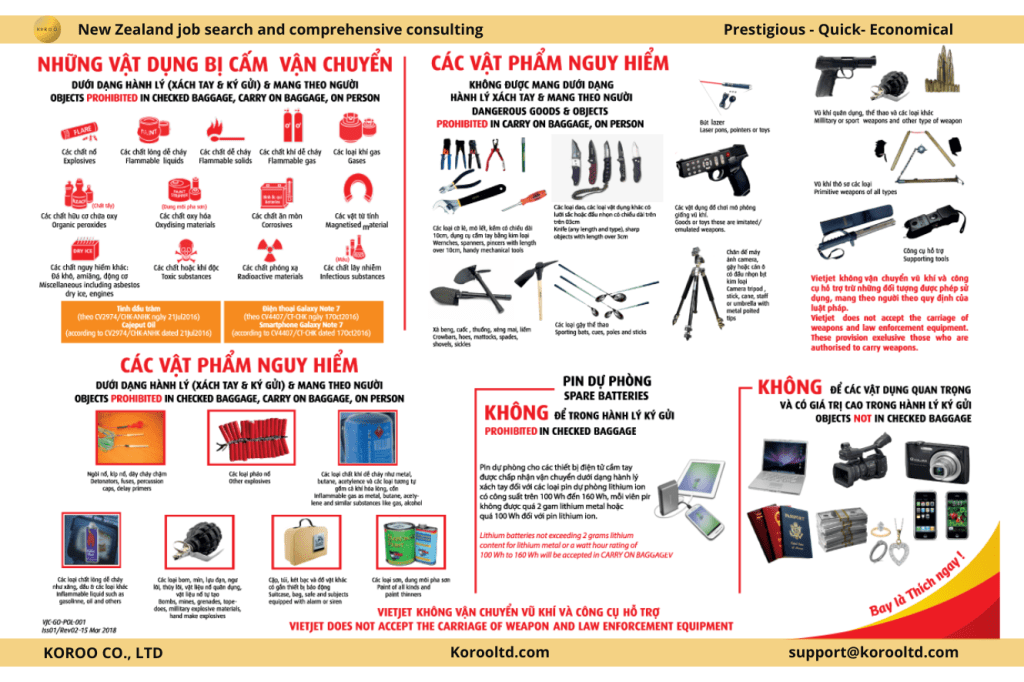
Refer to the detailed table below:
Contact us NOW for consulting and support in finding a job in New Zealand. Our full-service package includes airport pickup in New Zealand, exclusively.