New Zealand is not only a country known for its rich landscapes but also one that places great importance on workers’ rights. For this reason, many workers choose New Zealand as a destination for their career journey. Let’s explore the public holidays and leave regulations here with Koroo!
1. Public Holidays
You are entitled to a paid day off on public holidays if they fall on your usual working days. If you choose to work on that day, you will be paid at least 1.5 times your usual rate and will also receive a paid day off at a later date.
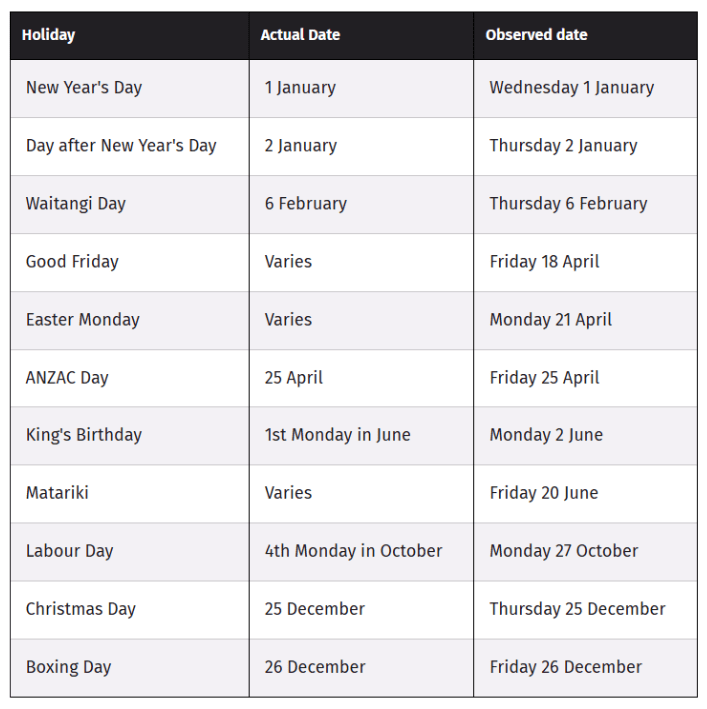
In New Zealand, public holidays may vary based on local customs and historical precedents. Sometimes, if a public holiday falls on a Saturday or Sunday, the holiday will be moved to the following Monday (or in some cases, Tuesday). This is called “Mondayization” If you are an employee who typically works on public holidays, you will be given a day off on Monday and receive the public holiday benefits for that specific day. However, if you work both on the actual holiday and the Monday holiday, you will only get one day off.
2. Leave Regulations in New Zealand
Employees are entitled to at least 4 weeks (20 days) of paid annual leave. Employees can take their leave consecutively for 2 weeks or split it for special circumstances. Employees can only take paid leave after completing 1 full year of service with the employer (unless otherwise agreed). Unused leave is automatically accumulated and carried over, but employers can request its use within the year. In some cases, employees may exchange one week of leave for cash.
Sick Leave
Sick leave is paid time off for when you need to care for yourself or a family member who is unwell. After six months of continuous employment, employees are entitled to at least 10 days of sick leave. By law, you can accumulate up to 20 sick days, and this number may increase if both you and your employer agree.
Maternity Leave
Maternity leave in New Zealand is available to employees who are pregnant, have recently given birth, or are the partner of the pregnant employee. The duration of maternity leave depends on the employee’s length of service with the employer:
- 6 months before the expected due date: 26 weeks of paid primary caregiver leave and an additional 4 weeks of unpaid child care leave.
- 12 months before the expected due date: 26 weeks of paid primary caregiver leave and an additional 26 weeks of unpaid child care leave.
Bereavement Leave
Employees are entitled to 3 days of paid bereavement leave when a close family member passes away, including parents, spouse/partner, children, grandparents, or in-laws. If more than one death occurs within a month, employees may be entitled to an additional 3 days of bereavement leave.
>>Note: This applies to employees who have worked continuously for six months. If not, to be eligible for bereavement leave, employees must have worked at least 10 hours per week on average since the start of their employment, with at least one hour per week or 40 hours per month.
Parental Leave
Parental leave allows employees to take time off to care for a newborn:
- Primary caregiver leave: Up to 22 weeks of paid leave if you are the primary caregiver for the child.
- Special leave: Up to 10 days of unpaid leave for pregnancy-related activities such as prenatal classes, ultrasounds, or midwife appointments.
- Partner leave: Up to two weeks of unpaid leave if you are the partner of the primary caregiver.
Additionally, you may negotiate extended leave of up to 52 weeks of unpaid leave with your employer, depending on the agreement.
Primary caregivers can transfer some of their unpaid leave (4-26 weeks) to their partner.
>>Note: If the baby is born prematurely (before 37 weeks), the primary caregiver and the partner may receive additional leave and benefits.
Family Violence Leave
Employees affected by domestic violence are entitled to up to 10 days of paid leave per year to address the consequences of family violence.
Jury Service Leave
If you are called for jury duty, you are entitled to take time off from work while your job is protected. However, this leave is unpaid.
Other Types of Leave
In addition to the above, employees may be entitled to leave for other reasons such as:
- Labour relations education leave
- Voting leave
- Participation in volunteer national defense activities
These types of leave may be regulated by law or negotiated between the employer and employee.
The information above provides a complete and easy-to-understand overview of the leave types available in New Zealand, helping you understand your leave rights. For more detailed information, you can refer to Employment.govt.nz.
Note: The leave days and allowances mentioned above are subject to the employer’s regulations and the agreement between both parties.
This translation provides clear and accurate information about public holidays and leave regulations in New Zealand, ensuring readers understand their rights and benefits.