In a report based on the hypothesis “Money can’t buy happiness” researchers at Purdue University suggest that a specific income level is needed to truly be happy, depending on where you live.
The happiness level mentioned in the report is not just about basic spending for household living expenses. Furthermore, happiness is seen as your ability to afford regular vacations. Of course, this is not possible for most foreign workers.
New Zealand is one of the world’s 7th most expensive places to seek happiness. As expected, the two major cities, Auckland and Wellington, top this list of expensive places. With a cost of NZD 207,000 per year, New Zealand ranks 20th globally. Compared to Christchurch, the cheapest Kiwi city in the survey, where happiness costs a steep NZD 180,000 per year. For workers, they only need less than NZD 10,000 to live comfortably in New Zealand. The average income in New Zealand is USD 48,249.3, but when it comes to “luxury happiness,” it makes everyone feel disheartened.
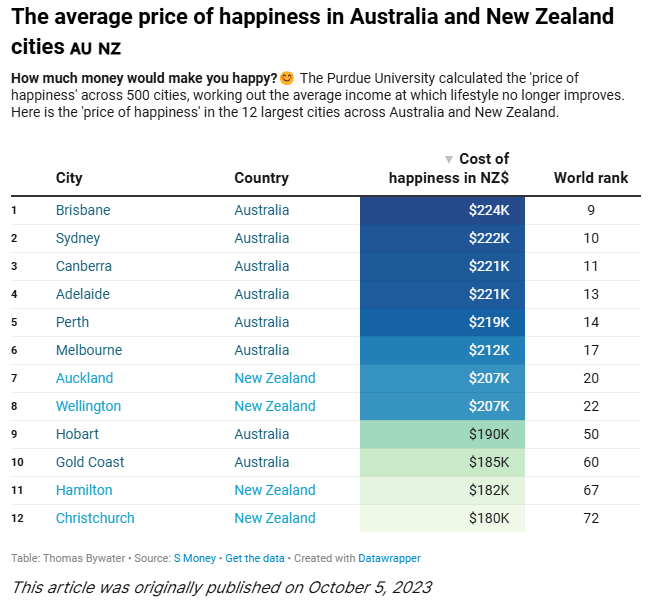
The most expensive country to live in is the Islamic Republic of Iran, where Iranians believe happiness costs USD 239,700. Meanwhile, the average household income in Iran is USD 3,340 in urban areas and USD 1,973 in rural areas, according to the Iranian Statistical Center. Across the channel in Australia, happiness is even more expensive. Australia is considered the third most expensive place in the world to seek happiness, with Brisbane and Sydney both making the top 10 most expensive cities for happiness. The average cost of happiness is reportedly USD 205,830. This figure rises to USD 225,511 in Brisbane, where Australians spend the most on life satisfaction.
What is the true cost of happiness?
Returning to the main hypothesis in the report, “Money can’t buy happiness, but it can buy you a vacation.” While happiness is closely tied to the cost of living, it can also relate to the amount needed to cover “unhappiness.” According to Harvard’s Department of Psychology, the relationship between money and happiness is surprisingly fragile: “If money doesn’t bring you happiness, you’re not spending it right.” Participants in the report suggested that they feel happier experiencing a vacation than saving to buy something they want. With these results, Professor Daniel T. Gilbert stated that the anticipation of going on a trip is often greater than the happiness the vacation itself brings.
In conclusion, the cost of seeking happiness abroad is too extravagant, and not everyone desires it. For foreign workers in New Zealand, with the current average income, they can afford to live and even accumulate savings when they return home. Happiness is knowing enough and not seeking excessive luxuries that exceed your limits.
Find and consult job opportunities in New Zealand, CONTACT NOW!